Why Some Oakville Homes Sell In A Week And Others Sit For Half A Year
September 3, 2026
September 3, 2026
Ask three sources how long it takes to sell a house in Oakville and you'll get three different answers, and none of them are wrong.
Redfin's tracking of closed sales put the median at 10 days on market in March 2026, up from 6 days the year before but still fast by any normal measure. Zillow's pending-sale data, current as of mid-2026, has homes going under contract in around 5 days. But pull up the live inventory feed for the same ZIP code in mid-August 2026, and the average sits at 58 days across 114 active listings, with a median list price of $379,900. That's not a typo and it's not three different housing markets pretending to be one. It's the same 63129 ZIP code, measured two different ways, and the gap between them is the most useful piece of information a buyer or seller can have before they price a house here.
The fast numbers, the 5-to-10-day figures, are built from homes that already sold. They're a snapshot of the winners: the properties that got priced right, showed well, and cleared. The slower number, the 58-day average, includes everything currently sitting on the market, winners and stragglers together. A standard three-bedroom ranch that goes under contract in a week barely shows up in that average before it disappears from the "active" count. A harder-to-place property that's been sitting since spring stays in that average the entire time, dragging it upward every day it doesn't sell.
That's the mechanical explanation. The interesting question is what kind of house is doing the dragging, and in Oakville the answer isn't random. It's geographic.
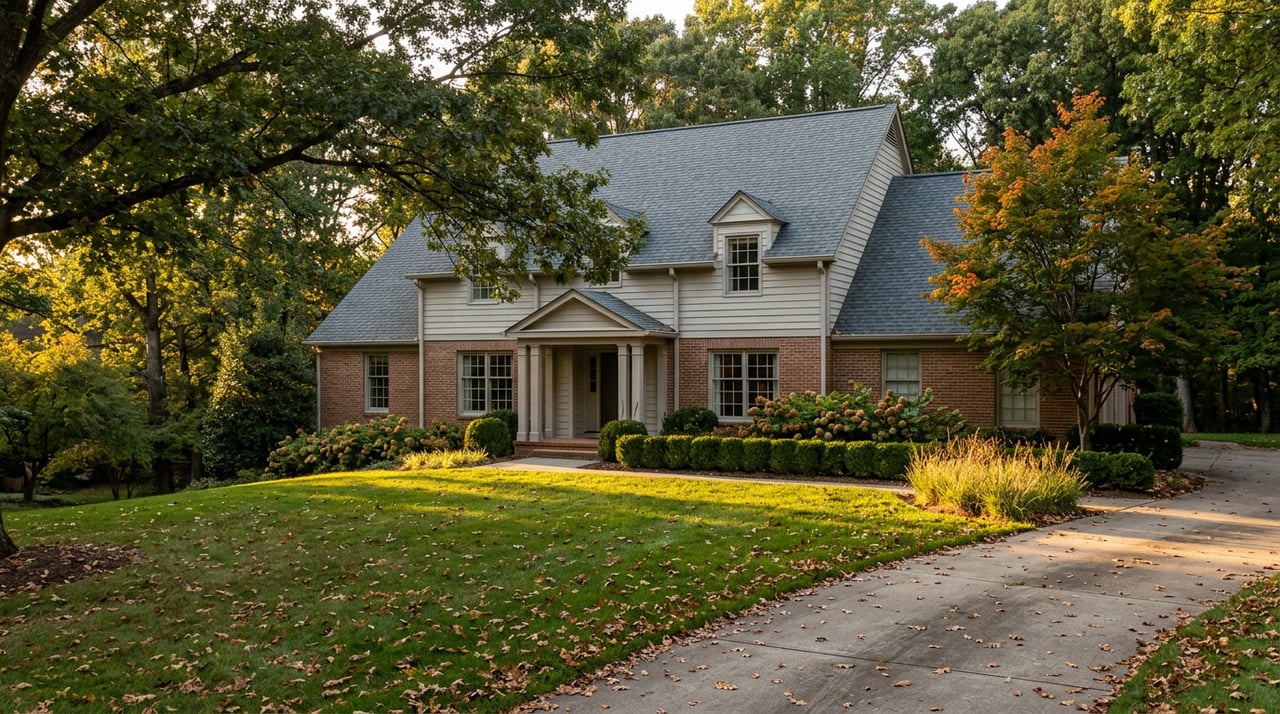
Oakville sits between the Mississippi and the Meramec, and the land itself isn't flat. Most of the ZIP code is interior subdivision: ranch houses, split-levels, and Colonial Revivals built from the 1970s through the 1990s on standard lots, feeding into Mehlville schools, the kind of housing stock that makes up the bulk of what actually closes in a week or two. Then there's the bluff side and the acreage side, a smaller slice of the market where the product is genuinely different: bluff-top river-view lots in subdivisions like Fordyce Bluffs, older established subdivisions like River Oaks, and Jacob Westerman Estates, whose last available lot backs directly to the Meramec on more than two private acres.
That second category doesn't move like the first. A 4.23-acre parcel on Fine Road, listed at $925,000 and part of a rezoned subdivision called Ladera Manor approved for 14 single-family lots, spent 185 days on site before it found a buyer. That's not a distressed listing. It's a specialized one. Custom acreage and river-bluff property draws from a much smaller pool of buyers who want that specific thing, and a smaller pool takes longer to clear, no matter how well the property is priced or marketed.
A Keller Williams agent who's worked the area for 21 years put the pricing pattern plainly: the higher priced homes cluster on the eastern side, where the river views are. That's the same split showing up in the numbers. Census-tract data for the neighborhood also splits along similar lines, with the southern slice of Oakville running a median several thousand dollars above the ZIP code as a whole. It's not that one side is simply "more expensive." It's that the eastern and southern edges are selling a different product to a different buyer.
| Interior Subdivision | Bluff / Acreage | |
|---|---|---|
| Typical build era | 1970s–1990s | Mix of older estate lots and new rezoned parcels |
| Typical lot | Standard subdivision lot | 0.5 to 4+ acres, often river-adjacent |
| Recent example | Standard 3-bed ranch, Mehlville district | Jacob Westerman Estates, 2.41 acres backing the Meramec |
| Time to sell | Days to roughly two weeks | Months, sometimes 5–6 |
| Buyer pool | Broad: move-up families, first-time buyers | Narrow: custom-build and river-view seekers |
The median sale price for the ZIP code, right around $375,000 in March 2026 at roughly $178 a square foot, is a blend of both columns. It tells you almost nothing about which experience you're about to have. A buyer shopping the interior side should expect to compete, write a clean offer, and move fast. A buyer shopping the bluff side should expect a longer runway, fewer comparable sales to lean on, and a seller who has likely already sat through a slow spring.
If you own a standard subdivision home in Oakville, the current data argues for treating this as a seller's market and pricing accordingly. Homes in this category are the ones producing the 5-to-10-day headlines, and overpricing even slightly risks missing that window and sliding into the slower, 58-day pool by default.
If you own something on the bluff, along the river, or on multiple acres, the strategy has to be different. These aren't slow sales because something is wrong. They're slow because the property is speaking to a smaller audience, and marketing has to work harder to reach that audience specifically, whether that's builders looking at a rezoned parcel like Ladera Manor or a family that wants the Meramec in their backyard rather than a highway. Pricing patience into the plan from day one, rather than discovering it three months in, changes how a seller experiences the process.
For buyers, the read is just as practical. If your search keeps landing on the interior subdivisions and you're watching listings disappear before you can tour them, that's not bad luck, that's the fast side of the market behaving exactly as the data says it does. If you're chasing a river view or an acreage lot and the process feels slower than what a friend described from three streets over, that's also expected. You're shopping in the other column of the table.
Does a longer time on market mean something is wrong with the bluff-side homes? Not necessarily. A smaller buyer pool for custom and acreage product means longer average marketing time even for well-priced, well-maintained homes. The 185-day Fine Road parcel is a land example, not a red flag example.
Is the interior subdivision side actually cheaper, or just faster? Both, generally. It's faster because more buyers compete for a more standard product, and that competition is also what keeps those homes trading near or above list.
How do I find out which side of this line a specific address falls on? Lot size and proximity to the river or the bluff edge are the practical markers. A subdivision plat that backs to Cliff Cave Road, the Meramec, or the Mississippi bluff behaves differently than a standard interior street, even a few blocks away.
The median price on any portal will tell you what Oakville costs on average. It won't tell you whether your specific search, or your specific listing, belongs to the fast column or the slow one. That distinction is the difference between pricing a home that sells in ten days and pricing one that needs a five-month runway, and it's worth knowing before either number becomes yours.
If you're weighing a purchase or a sale on either side of that line, Stacy Deutschmann works Oakville street by street. Let's connect and find your next home, or get a free valuation that accounts for which market you're actually in.
Let me guide you through the complexities of buying or selling your home, eliminating hassles and stress. I look forward to working with you!